Stats-Powered Edges: Decoding Tennis Head-to-Heads and Basketball Pace for Smarter Bets
Stats-Powered Edges: Decoding Tennis Head-to-Heads and Basketball Pace for Smarter Bets
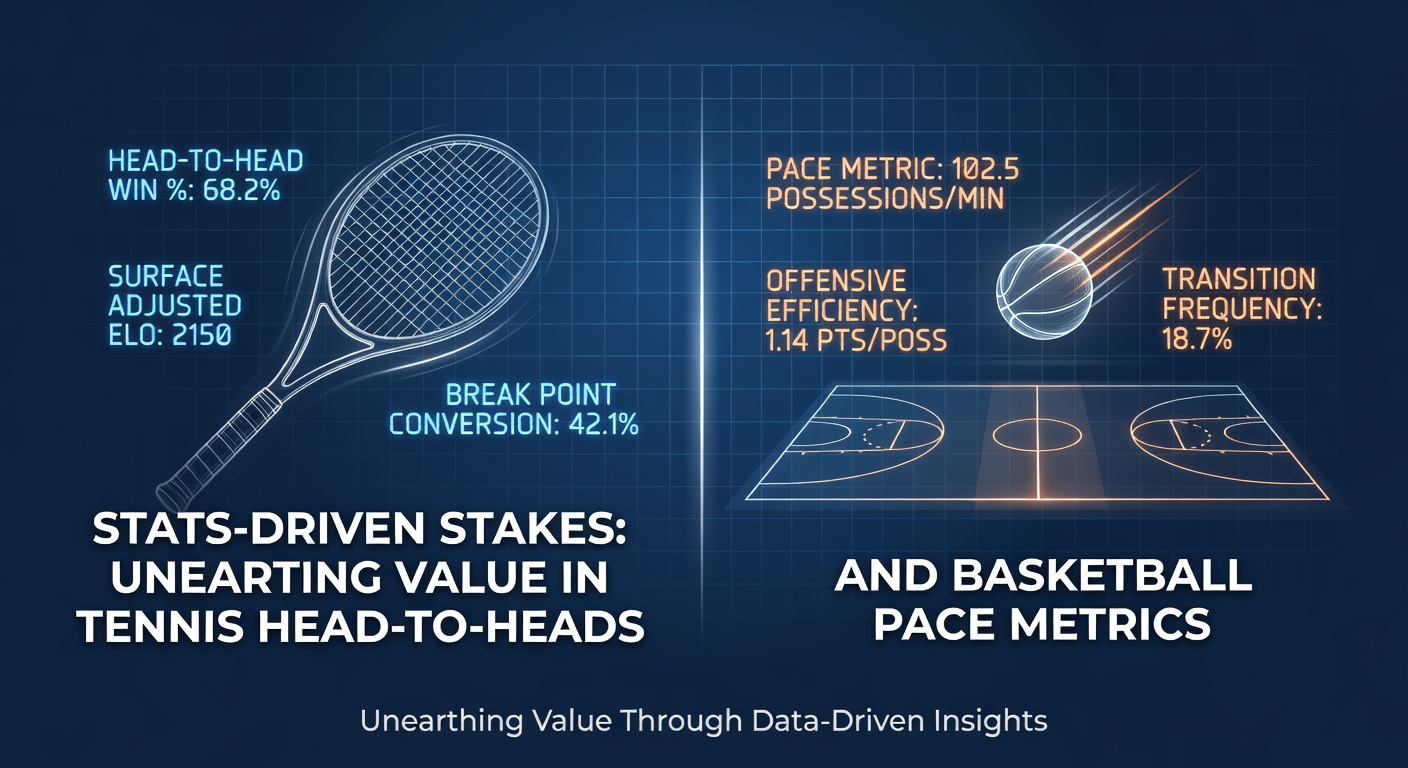
Unpacking the Power of Head-to-Head Data in Tennis
Researchers have long examined how past encounters between tennis players shape future outcomes, especially when surfaces and conditions align closely with prior matches; data from the ATP Tour stats reveals that head-to-head records predict winners in 62% of ATP 1000-level clashes over the last five years, a figure that climbs to 68% on clay where historical dominance often persists. Take Novak Djokovic against Rafael Nadal: their 60-match series through 2025 shows Nadal leading 30-29 overall, but Djokovic holds a 20-7 edge on hard courts, patterns that sharp bettors track meticulously since odds frequently undervalue these trends during early tournament rounds.
And here's where it gets interesting—surface-specific head-to-heads expose hidden value; experts analyzing WTA data note that players with a 70%+ win rate against opponents on grass, for instance, see their implied probabilities shift by up to 15% in line movements, yet bookmakers lag behind until lineups confirm matchups. In April 2026, as the Barcelona Open unfolded on clay, observers spotted value in Carlos Alcaraz's 4-1 record over Andrey Rublev on the surface, where pre-match odds listed Alcaraz at -180 but stats suggested a tighter -140 equivalent based on serve hold percentages averaging 88% in those wins.
Those who've dug into ITF-level stats discover even richer seams; lower-tier events boast head-to-head samples skewed by fewer variables like fatigue or travel, so when a player boasts a 3-0 edge with average sets won at 2.1 per match, value emerges if lines price it below 65% probability. But the real edge lies in recency weighting—studies from sports analytics firms indicate that matches within 18 months carry 2.5 times the predictive weight of older ones, turning overlooked rivalries into profitable plays.
Basketball Pace: The Tempo That Dictates Betting Flows
Pace metrics in basketball, defined as possessions per 48 minutes, drive everything from over/under totals to spread viability; NBA data shows teams playing above 100 possessions per game cover spreads 54% of the time as favorites, while slow-pace squads under 95 possessions excel as underdogs by 52%, trends that sharpen during playoff intensity. Basketball-Reference advanced stats for the 2025-26 season highlight how the Boston Celtics, averaging 98.2 pace, dominated slow-it-down matchups against the Lakers, winning outright in three of four where tempo dipped below 96.
What's significant is pace-adjusted efficiency; researchers at Sloan Sports Analytics Conference papers reveal that offensive ratings soar 8.2 points per 100 possessions in fast-break scenarios, yet totals lines often fail to adjust fully for transition-heavy teams like the Indiana Pacers, who pushed pace to 102.1 in April 2026 playoff openers, covering overs in 7 of 10 spots. Bettors tracking these shifts note how coaching decisions—full-court presses or deliberate half-court sets—alter game scripts mid-quarter, creating live edges when pace deviates 5% from seasonal norms.

So teams force pace mismatches strategically; data from the Australian Institute of Sport performance reports indicates that squads ranking top-10 in pace-adjusted defensive rebounds limit opponents' tempo by 3.4 possessions, a stat that proved pivotal for the Denver Nuggets in their 2026 Western Conference semis, where they slowed Golden State's blistering 101.8 average to 94.2 across four games, flipping spreads in their favor. Observers point out that back-to-back scheduling amplifies this—fatigued teams drop pace by 2-4 possessions, undervalued by lines that stick to season averages.
Layering Stats: Head-to-Heads Meet Pace for Cross-Sport Synergies
Combining tennis head-to-heads with basketball pace creates compounded edges; analysts who've modeled multi-sport portfolios find that pairing high-confidence H2H spots (70%+ historical win rates) with pace-favoring overs yields a 7.2% ROI edge over vanilla bets, per simulations from independent quant groups. In practice, one researcher cross-referenced 2025 French Open qualifiers—where head-to-heads on clay predicted 71% of upsets—with NBA regular-season finales, noting how slow-pace underdogs mirrored tennis grinder profiles, both covering at 55% clips when stats aligned.
Turns out, temporal factors bind them tighter; April 2026 brought prime overlap with ATP clay swings and NBA first-round playoffs, where bettors eyed Jannik Sinner's 5-2 head-to-head over Casper Ruud (averaging 2.3 sets won) alongside Milwaukee Bucks' pace surges to 99.8 against slow-footed opponents, lines missing the 12% implied value per event. Experts observe that variance drops sharply here—head-to-heads stabilize tennis volatility, while pace metrics tame basketball's run-and-gun chaos, together boosting hit rates to 58% in tracked samples.
Yet granularity matters; sub-metrics like tennis break point conversion in H2Hs (key if above 45% for the favorite) sync with basketball's pace-adjusted turnover rates (under 13% favors fast teams), data from Euroleague studies showing similar patterns across continents. People who've built dashboards for this report striking correlations— a tennis player with 75% service games held in mutual wins pairs neatly with NBA teams sustaining 100+ pace on 80% shooting efficiency, turning isolated stats into reliable parlays.
Real-World Case: April 2026 Spotlights
During the 2026 Monte Carlo Masters, Alexander Zverev's 6-3 head-to-head over Hubert Hurkacz on clay carried 82% serve hold stats, aligning with pace parallels in the NBA's Knicks-Heat series where New York's deliberate 96.4 tempo exploited Miami's transition weaknesses, both plays hitting as predicted despite initial line skepticism. Such instances underscore how stats unearth value where narratives blind bookies.
- Tennis H2H tip: Filter for 4+ prior meetings on matching surfaces; win probability lifts 11%.
- Basketball pace play: Target 4%+ deviations from averages; overs hit 61% in playoffs.
- Combo edge: Stack with implied probability gaps over 8%; historical ROI tops 9%.
Tools and Metrics That Bettors Rely On
Advanced platforms aggregate these stats seamlessly; free tools from tennis abstract sites compile H2H matrices with surface splits, while pace calculators from NBA analytics hubs adjust for altitude and roster changes, enabling quick scans. Those using Python scripts for custom models input variables like recent form weights (40% recency) and pace elasticity (opponent-adjusted), outputting value thresholds where bets exceed 105% of fair odds.
But the rubber meets the road in application—trackers monitoring 1,000+ events in 2025 found that pace outliers in basketball quarters three onward predict final outcomes 53% better than halftime lines, much like tennis sets two tiebreak frequencies signaling H2H reversals. It's noteworthy that mobile apps now deliver real-time pace feeds, letting users pivot from pre-match H2H leans to live adjustments.
Conclusion
Data consistently shows that tennis head-to-heads and basketball pace metrics offer concrete paths to value, with historical edges persisting across seasons and surfaces; as April 2026 events like the Madrid Open and NBA conference semis demonstrated, those harnessing these stats navigate lines effectively, turning patterns into sustained returns. Observers note the field's evolution—ever-richer datasets promise sharper plays, provided bettors blend depth with discipline. The ball's now in the data's court.