Seasonal Pattern Recognition for Multi-Sport Accumulator Refinement
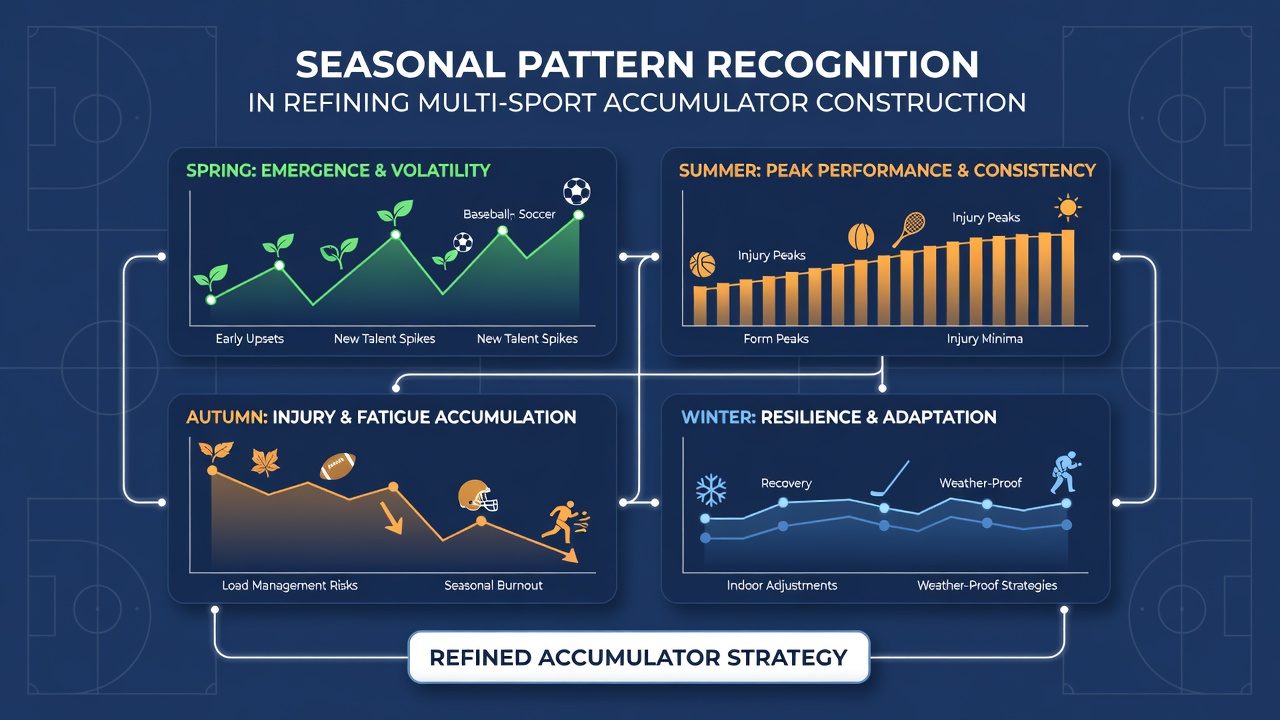
Seasonal shifts create measurable patterns that analysts track when constructing accumulators spanning football, basketball, tennis, and horse racing, and those patterns become clearer when data sets from multiple years are aligned against fixture calendars. Observers note that summer months often coincide with pre-season tournaments in football alongside grass-court tennis events, while basketball transitions into off-season development programs that influence future betting markets. Data from international sports bodies shows these calendar alignments produce repeatable statistical clusters around goal averages, set completion rates, and pace metrics that can be layered into multi-leg selections.
Calendar Alignment Across Disciplines
Football leagues in Europe typically enter pre-season phases during July, and this period generates distinct patterns in friendly match outcomes that differ from competitive fixtures, whereas tennis schedules peak around Wimbledon in the same month with surface-specific adjustments in player performance data. Horse racing calendars in the northern hemisphere move into mid-summer festival circuits, producing shifts in trainer strike rates that researchers have documented through longitudinal studies. When these calendars overlap, accumulator builders examine correlations between early football goal tallies and tennis tie-break frequencies to identify combinations that historically cluster around certain payout thresholds.
Data Layers That Reveal Patterns
Multiple data streams converge when analysts map seasonal variables, and these include weather-adjusted pitch conditions for football, court speed ratings for tennis, and track variant reports for racing. Studies published by academic sports science departments indicate that combining these variables reduces variance in projected accumulator returns compared with single-sport models alone. In July 2026, several European football clubs will conduct training camps in high-altitude locations, a factor that has previously correlated with elevated injury rates upon return to domestic fixtures and therefore appears in pattern matrices used for accumulator timing.
Constructing Accumulators With Pattern Inputs
Accumulator construction begins with identification of high-probability legs drawn from seasonal baselines, then proceeds to cross-sport validation where tennis serve percentages during July grass events are checked against football over/under totals from the same week. Pattern recognition software processes historical datasets to flag instances where basketball summer league scoring trends have aligned with subsequent NBA regular-season totals, allowing builders to insert or exclude legs accordingly. Those who apply these methods report that multi-sport selections built around verified seasonal clusters show tighter distribution around expected value ranges than selections assembled without calendar context.

Regional Variations and July Timing
North American sports calendars introduce additional layers during July, with Major League Baseball reaching its midpoint and generating pace statistics that occasionally intersect with European football friendlies in accumulator models. Reports from the Australian Institute of Criminology on cross-border betting flows highlight how southern hemisphere winter racing circuits produce counter-seasonal data points that some builders incorporate to balance northern summer selections. Pattern recognition therefore extends beyond single-hemisphere calendars to include these offset cycles when constructing accumulators that span multiple continents.
Validation Through Historical Clusters
Validation steps involve back-testing seasonal clusters against actual outcomes, and this process reveals which combinations of football clean-sheet rates, tennis break-point conversion, and racing distance preferences have produced consistent accumulator structures across five-year windows. Industry organizations such as the Canadian Gaming Association publish aggregated transaction data that analysts cross-reference with fixture schedules to confirm whether July spikes in multi-sport wagering volume correspond to particular pattern alignments. Such cross-checks help refine leg selection criteria without introducing unverified assumptions into the construction process.
Conclusion
Seasonal pattern recognition supplies a structured framework for refining multi-sport accumulator construction by aligning calendar-driven statistical clusters across football, basketball, tennis, and horse racing. Data sources from regulatory bodies, academic departments, and industry associations supply the raw material for these alignments, while July 2026 fixture overlaps offer fresh opportunities to test existing pattern matrices. Observers continue to monitor how these methods evolve as new seasonal datasets become available.