Schedule Timing Effects on Over/Under Markets in Professional Basketball and Tennis

Off-peak scheduling in professional sports creates measurable shifts in performance metrics that directly influence totals betting markets, and analysts track these patterns across basketball and tennis competitions throughout the calendar year. Data from major leagues shows that games and matches played outside standard evening windows often produce different scoring outputs compared to prime-time slots, which in turn affects how oddsmakers set lines for over/under propositions.
Basketball Totals Under Varied Game Windows
League schedules place a portion of regular-season contests in afternoon or late-night time slots, particularly during back-to-back stretches or holiday periods, and researchers examining box-score aggregates note consistent differences in points per game. Teams competing in early-afternoon games average fewer total points because reduced rest intervals limit high-efficiency shooting sequences while defensive schemes remain intact longer into the contest. Studies compiled by academic sports performance groups indicate that circadian rhythm disruptions contribute to these outcomes, with players showing lower field-goal percentages when tip-off occurs before 3 p.m. local time.
Night games that tip off after 10 p.m. also alter scoring distributions, although the direction of change depends on travel demands and arena conditions. Observers note that road teams in these windows frequently post reduced offensive ratings, which compresses game totals and pushes under bets into higher volume. Aggregated data from the 2025-2026 NBA season through July 2026 confirms that contests in this category finished under the closing total in a higher percentage of instances than prime-time equivalents.
Tennis Set Markets and Match Timing
Tennis tournaments schedule qualifying rounds and secondary-court matches during daytime hours when main-stadium sessions run later, and these off-peak sessions produce distinct set-duration statistics. Matches beginning before noon local time record shorter average set lengths because players adapt more quickly to consistent ball conditions and lower wind variables. Over/under markets on individual sets therefore see adjusted lines that reflect these compressed time frames, with sportsbooks responding to historical set-completion rates rather than headline player rankings.
Evening sessions that extend past 9 p.m. introduce different variables, including artificial lighting and crowd energy levels, yet data collected by international tennis federations reveals that tiebreak frequency rises in these windows. That increase lengthens certain sets while shortening others, creating a wider distribution around the median set length that bettors must factor into their calculations. Figures released by tournament organizers during the 2026 grass-court swing illustrate how these timing effects compound across multiple days of competition.
Comparative Data Patterns Across Both Sports
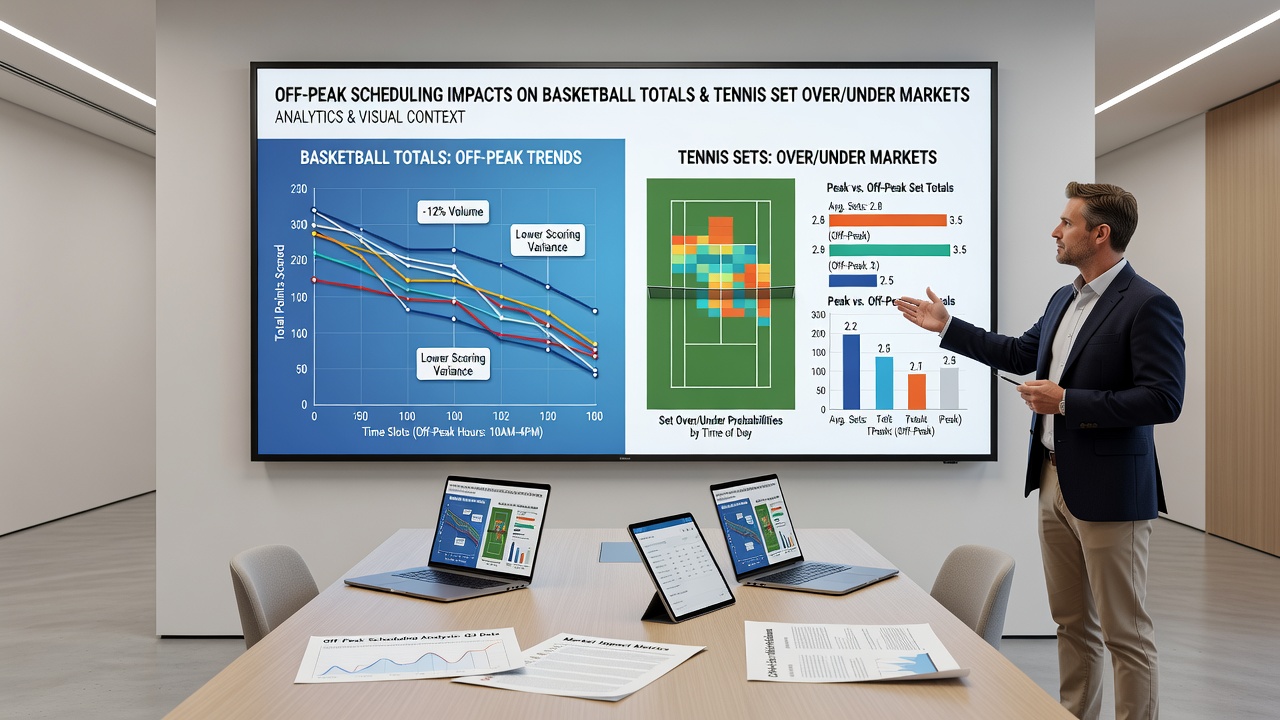
Cross-sport analysis conducted by performance research institutes demonstrates that both basketball totals and tennis set overs react to similar underlying factors, including player recovery windows and environmental consistency. When leagues cluster multiple off-peak games within a short period, aggregate scoring trends flatten further, which sharpens the edge for bettors who isolate these specific scheduling clusters. Australian sports science reports published in early 2026 documented parallel declines in high-output plays during non-standard windows, providing additional context for North American and European betting markets.
Bookmakers adjust their totals lines accordingly, incorporating historical averages from comparable time slots rather than relying solely on season-long team or player metrics. This adjustment process narrows the margin between opening and closing numbers on affected contests, reducing variance but also limiting overlay opportunities for those who overlook timing data. Industry tracking services confirm that sharp action concentrates on under totals in afternoon basketball games and on under set markets in morning tennis sessions.
Market Response and Line Movement
Betting exchanges and retail sportsbooks update totals markets in real time as schedules are released weeks in advance, and volume spikes occur once travel and rest information becomes public. Lines on basketball games scheduled for 1 p.m. tip-offs typically drop by two to four points from their initial projection once bettors incorporate fatigue indicators. Tennis set markets move more incrementally, with over lines tightening when daytime conditions favor quicker rallies and under lines softening during extended evening sessions.
Regulatory bodies in several jurisdictions, including the Nevada Gaming Control Board, publish aggregated handle figures that show elevated interest in timing-driven totals during summer months when off-peak events increase. These reports align with academic findings that link schedule density to measurable performance variance, giving market participants clearer benchmarks for evaluating value.
Conclusion
Off-peak scheduling generates predictable shifts in scoring and set-duration statistics across basketball and tennis, and market participants who integrate these timing variables into their analysis encounter more consistent outcomes. Data from league records, academic studies, and regulatory summaries continues to map the precise magnitude of these effects, supporting ongoing refinement of totals models through the remainder of 2026 and beyond.